
Skip to content

How to Choose a DC Fast Charging Station for Your Business?

Choosing a DC Fast Charging Station is not just a question of charger speed. It is a business decision shaped by vehicle traffic, site capacity, customer habits, and the time drivers can spare. A station beside a busy highway faces different demands from one serving a hotel, fleet depot, or shopping center. Look closely at the practical details: available electrical capacity, connector compatibility, cable reach, payment options, and room for vehicles to queue. A charger rated at high power may still underperform if the site cannot supply that power consistently. Small details matter.

As Tesla CEO Elon Musk has said, “The Supercharger network is one of the biggest advantages Tesla has.” The point for businesses is broader than any single network: dependable charging can influence where drivers stop and return. Yet the right equipment depends on more than brand recognition. Compare expected daily sessions, installation costs, service support, software features, and expansion options. Ask suppliers how they handle faults, parts, and remote monitoring—not only how quickly a charger can deliver energy on a perfect day. Real sites are less tidy.

This guide explains how to assess those trade-offs before committing. It covers power levels, site readiness, operating costs, user experience, and future growth. No single specification guarantees a successful project. A careful choice begins with the drivers your site actually serves, then tests assumptions against realistic traffic and electrical constraints. Some estimates will be wrong. Review them before they become expensive hardware decisions.
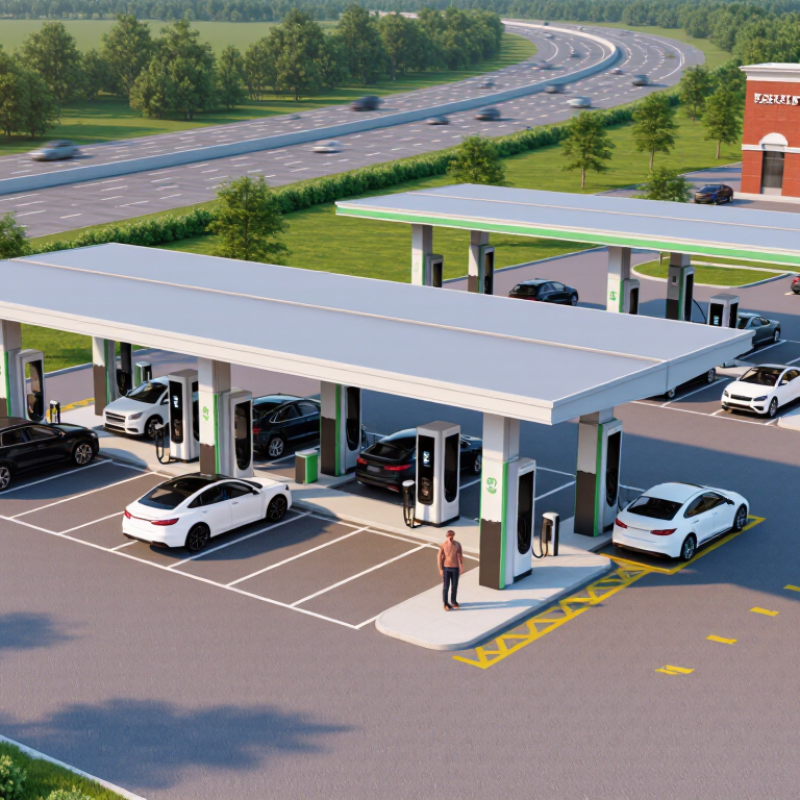
How to Choose a DC Fast Charging Station for Your Business?

Define Your Business’s Charging Needs and Usage Goals

Start with who will charge, and when. A hotel guest may park for hours, while a delivery van may need a quick turnaround. Count vehicles by hour, typical parking time, daily mileage, and expected charging sessions. These details help determine charger power and connector count. IEA’s Global EV Outlook 2024 reports that public charging points grew by 40% in 2023, while fast chargers grew by 55%. That signals a fast-changing market, not guaranteed local demand. A forecast can miss.

Estimate peak use, not just daily totals. If several vehicles arrive after work, limited electrical capacity may create queues even when chargers appear adequate on paper. Ask an electrician to review the site’s service capacity, upgrade costs, and room for future equipment. Compare the cost of a larger installation with the cost of turning drivers away. Leave some margin. It is easy to overestimate early demand, too.

Tips: Track arrivals and charging duration for several weeks. Separate employee, fleet, and visitor needs. Set a measurable goal, such as serving a target number of vehicles each day. Recheck it after launch; actual usage may surprise you.

Assess Site Capacity, Grid Access, and Installation Requirements

How to Choose a DC Fast Charging Station for Your Business?

Assess the site’s electrical capacity before comparing charger power ratings. A high-output unit can exceed the spare capacity of an older building, especially when HVAC, refrigeration, or workshop equipment runs at the same time. Ask an electrical engineer to review interval load data, service-panel ratings, transformer capacity, and available space for switchgear. Model realistic charging sessions, not just the maximum number of plugs. The difference matters.

Grid access can shape both cost and schedule. The International Energy Agency’s Global EV Outlook 2024 reports that public charging points grew by about 40% worldwide in 2023, while public fast chargers grew by 55%. That expansion makes early utility coordination important: confirm nearby feeder capacity, connection costs, upgrade responsibilities, and expected lead times. Walk the proposed cable route, too. A short distance on a map may still mean trenching through paving or relocating drainage. A spreadsheet will miss some of that.

Tips: Request a utility capacity assessment before ordering equipment. Check whether the site needs a new transformer, accessible parking layout, drainage work, or construction permits. Leave room for future expansion, but avoid paying for unused capacity today. Record assumptions; they may prove wrong once excavation begins.

Compare Charger Power, Connector Types, and Network Features

A DC fast charger should match the vehicles, dwell time, and electrical capacity at your site. A delivery van parked for 40 minutes may benefit from a different power level than a car stopping briefly. Higher-rated equipment can shorten charging, but only when the vehicle accepts that power and the site can supply it. The International Energy Agency’s Global EV Outlook 2024 reports that public fast chargers grew 55% worldwide in 2023. Demand is moving quickly, but buying the highest rating is not automatically the best choice.

Connector compatibility matters just as much. Check the actual vehicles your customers or fleet use, including whether they need CCS1, CCS2, CHAdeMO, or NACS connectors. A connector list in a proposal is not enough; verify cable reach and parking layout on site. Small details matter. A cable that barely reaches the inlet can turn a new charger into a daily annoyance.

Network features affect operations after installation. Look for remote status checks, fault alerts, usage reports, and clear payment options. Open Charge Point Protocol support can help connect chargers with compatible management systems, though integration should be confirmed before purchase. NREL’s 2023 report, The 2030 National Charging Network, estimates that about 182,000 public DC fast-charging ports may be needed in the United States by 2030 under its modeled scenario. That estimate is not a forecast for every business. A neat spreadsheet can still miss peak-hour queues, utility limits, or unreliable mobile coverage. Check those conditions before finalizing the equipment mix.

How to Choose a DC Fast Charging Station for Your Business

Compare representative charger power classes, then check vehicle connector compatibility and the network features your site needs.

How to use this chart: 50 kW, 150 kW, and 350 kW are representative rated-power classes, not guaranteed charging speeds. Actual power depends on the vehicle, battery state, temperature, and site capacity. Before buying, confirm connector compatibility for the vehicles your customers drive (such as CCS or NACS in North America) and compare network capabilities such as remote monitoring, payment support, uptime reporting, and load management.

Check Safety Standards, Certifications, and Vehicle Compatibility

Before comparing charger power or price, check safety certification and vehicle fit. Look for equipment independently certified to relevant standards, such as UL 2202 for EV charging systems and UL 2231 for personnel protection. Confirm that the certification covers the exact cabinet and cable configuration being offered. A certificate for a related product is not enough. Local requirements vary, so have a qualified electrical professional verify the installation and protection details. Small labels matter.

Vehicle compatibility is just as practical. Check connector types, supported voltage, charging communication, and each vehicle’s maximum DC charging rate. A 350 kW station will not make a vehicle charge at 350 kW if its battery accepts less. Review the vehicles your staff, customers, or fleet actually use, including older models. Connector families such as CCS, CHAdeMO, and SAE J3400 may affect who can plug in without an adapter. The IEA’s Global EV Outlook 2024 reports that public charging points grew by more than 40% in 2023, while fast-charger numbers rose by 55%. That expansion makes compatibility harder to treat as an afterthought. A site plan can look complete on paper and still leave a driver facing the wrong plug. Check real vehicle specifications before signing off.

Evaluate Total Costs, Service Terms, and Supplier Support

A DC fast charger’s purchase price is only the visible part of its cost. Ask for an itemized estimate covering electrical upgrades, trenching, permits, commissioning, and network fees. A parking lot may need a new transformer, even when the charger fits neatly beside the curb. Request energy and demand-charge assumptions in writing, then compare them with your utility bills. Small details matter.

Review service terms before signing. Check response times for faults, repair coverage, replacement-part availability, and who pays for travel or after-hours work. “Uptime” can sound reassuring, but ask how it is measured and what exclusions apply. A unit unavailable on a busy Friday can frustrate drivers and staff. That matters. Confirm warranty length, software charges, and whether service continues if your site changes ownership.

Supplier support should start before delivery. Look for a site review, clear installation coordination, staff training, and a named contact for escalations. Ask how technicians access spare parts and how updates are communicated. Speak with operators managing similar traffic, if possible; their experience may reveal delays a proposal does not show. No estimate is perfect. Utility timelines can shift, so leave budget room rather than treating the first quote as a promise.

How to Choose a DC Fast Charging Station for Your Business? — Evaluate Total Costs, Service Terms, and Supplier Support

Compare these representative configurations as planning options. The best fit depends on expected vehicle dwell time, electrical capacity, site work, utilization, and the service level your business requires.

Evaluation Dimension Option A: 150 kW Option B: 180 kW Option C: 300 kW
Typical configuration One charger with two connector cables; power may be shared between two vehicles. One charger with two connector cables; suitable for sites with steady, moderate fast-charging demand. One high-power charger with two connector cables; may support faster charging for compatible vehicles, subject to power sharing.
Indicative installed cost Approximately $100,000–$200,000 per charger, including typical equipment and installation. Approximately $120,000–$240,000 per charger, including typical equipment and installation. Approximately $200,000–$400,000 per charger, including typical equipment and installation.
Potential cost drivers Distance to the electrical service, trenching, switchgear, utility upgrades, permitting, and local labor. Higher electrical demand and equipment requirements than a lower-power installation; site upgrades can add substantially to cost. Greater service capacity, transformer or switchgear upgrades, utility work, cooling requirements, and construction complexity.
Recurring operating costs to budget Network or software fees, maintenance, payment processing, electricity, and any utility demand charges. Network or software fees, maintenance, payment processing, electricity, and any utility demand charges. Network or software fees, maintenance, payment processing, electricity, and potentially higher demand-related charges.
Network and software fees Ask for a written schedule of recurring fees, transaction charges, roaming costs, and any price increases. Fees vary by contract and service scope. Compare per-charger and per-connector pricing, payment processing, reporting tools, and contract renewal terms. Confirm whether fees are based on charger count, connector count, or charging sessions, and whether advanced monitoring is included.
Warranty and service terms Request written coverage for charger hardware, parts, labor, exclusions, and the process for making a claim. Confirm the warranty term before purchase. Check whether field labor and replacement parts are covered, and whether service is available in your operating region. Confirm coverage for power modules and other replaceable components, repair logistics, and whether an extended service plan is available.
Service response and uptime Ask for defined response and restoration targets, support hours, escalation steps, and how uptime is measured. Confirm remote diagnostics, on-site dispatch availability, parts availability, and service-level remedies for missed targets. Seek clear escalation procedures and restoration targets, particularly if the charger is critical to fleet operations.
Supplier support to evaluate Request site-planning guidance, installation coordination, commissioning support, and operator training. Check support for utility coordination, software setup, payment configuration, and ongoing troubleshooting. Evaluate electrical engineering assistance, commissioning expertise, fleet integration support, and access to qualified field technicians.
Best suited to Businesses seeking a lower-power entry point or serving locations where vehicles typically stay longer. Sites balancing charging speed, installation scope, and expected vehicle turnover. High-throughput locations or fleet operations where vehicle compatibility and electrical capacity support higher-power charging.
Questions to ask before signing Is power shared across connectors? What work is excluded from the installation estimate? What are the annual software and service costs? What is included in the quoted price? Are utility upgrades, permits, and commissioning included? What response times are contractually guaranteed? Can the site supply the required power? What utility upgrades are needed? Are power sharing, service coverage, and parts lead times documented?

Planning note: Installed-cost figures are broad, indicative U.S. budget ranges—not supplier quotes. Actual costs vary substantially with utility capacity, civil work, permitting, location, and project scope. Electricity tariffs, demand charges, taxes, incentives, and financing are excluded; obtain a site assessment and written, itemized proposals before making a purchasing decision.