What is a Solar System and How Does it Work?
Understanding solar systems is vital in today's scientific landscape. Renowned astrophysicist Dr. Jane Holloway states, "Solar systems are the building blocks of our universe." This insight emphasizes their importance in both education and research.
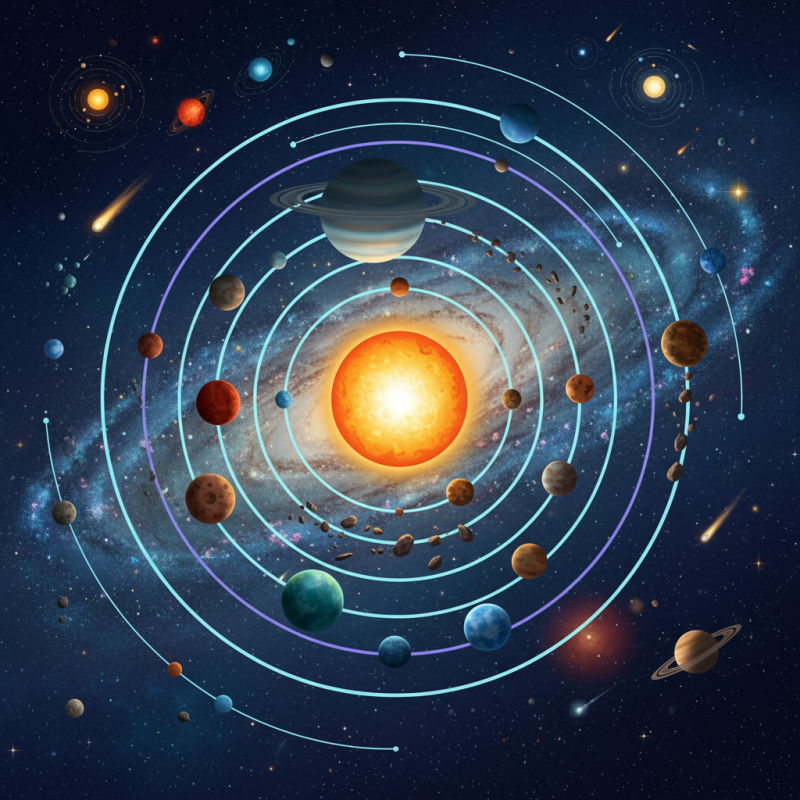
Solar systems encompass various celestial bodies, including planets, asteroids, and comets. Each system forms around a star, creating a complex dance of gravity and motion. For instance, our solar system consists of eight planets orbiting the Sun. However, many systems remain poorly understood, leaving gaps in our knowledge. Astrobiological potential and the search for life push us to explore these mysteries.
The beauty and complexity of solar systems intrigue many. Yet, challenges remain in studying them. Techniques and tools evolve, yet the vastness can overwhelm. Exploration of other systems may reveal answers or, at times, raise more questions. In essence, as we delve deeper, we must also reflect on what we truly know about our solar systems.
What Constitutes a Solar System? Defining Key Components
A solar system is a cosmic structure that includes a star and everything bound to it by gravity. This includes planets, moons, asteroids, comets, and other celestial bodies. Understanding what constitutes a solar system involves examining these key components closely.
The star, typically a sun-like object, serves as the heart. It provides light and heat, enabling life on its planets. The planets vary in size and type. Some are rocky, while others are gas giants. The orbits of these planets are not perfectly circular; they can be quite eccentric. Moons orbit planets, sometimes in unusual patterns. They can influence tides and even climate.
Asteroids and comets add complexity. Asteroids often reside in the asteroid belt, while comets hail from the outer reaches. Their paths are unpredictable. Not all solar systems are alike. Variations exist in size, composition, and distance from their stars. Exploring these differences prompts deeper questions about formation and evolution in space. The universe holds mysteries yet to be unveiled.
The Sun: A G-type Main-sequence Star and Its Characteristics
The Sun is a G-type main-sequence star, classified as G2V. It is primarily composed of hydrogen (about 74%) and helium (around 24%). This stellar classification affects its temperature and brightness. The surface temperature reaches approximately 5,500 degrees Celsius. Its luminosity is about 400 trillion trillion watts, a staggering number for any single entity.
Stars like the Sun have life cycles. They spend most of their time in a stable phase, known as the main sequence. For the Sun, this phase lasts around 10 billion years. It has been shining for about 4.6 billion years so far. As it ages, it will eventually expand into a red giant before shedding its outer layers. The core will collapse into a white dwarf over time.
The distance from Earth to the Sun is about 93 million miles, which is roughly 150 million kilometers. This distance is known as an Astronomical Unit (AU). Despite being so far away, it still exerts a significant gravitational force on all objects in the solar system. This keeps planets, including Earth, in stable orbits. Understanding sunlight is crucial; it drives the climate and supports life through photosynthesis. Yet, reliance on this star brings reflection on climate change and solar energy usage.
What is a Solar System and How Does it Work?
| Dimension |
Description |
| Definition |
A solar system consists of a star and all celestial objects bound to it by gravity, including planets, moons, asteroids, and comets. |
| Main Star Type |
G-type Main-sequence Star |
| Example Star |
The Sun |
| Number of Known Planets |
8 (Mercury, Venus, Earth, Mars, Jupiter, Saturn, Uranus, Neptune) |
| Outer Planets |
Jupiter, Saturn, Uranus, Neptune (Gas Giants) |
| Inner Planets |
Mercury, Venus, Earth, Mars (Terrestrial Planets) |
| Key Characteristic of the Sun |
It is primarily composed of hydrogen (about 74%) and helium (about 24%). |
| Solar System Age |
Approximately 4.6 billion years old |
| Formation |
Formed from the gravitational collapse of a region within a large molecular cloud. |
Planets and Their Classification: Terrestrial vs. Gas Giants
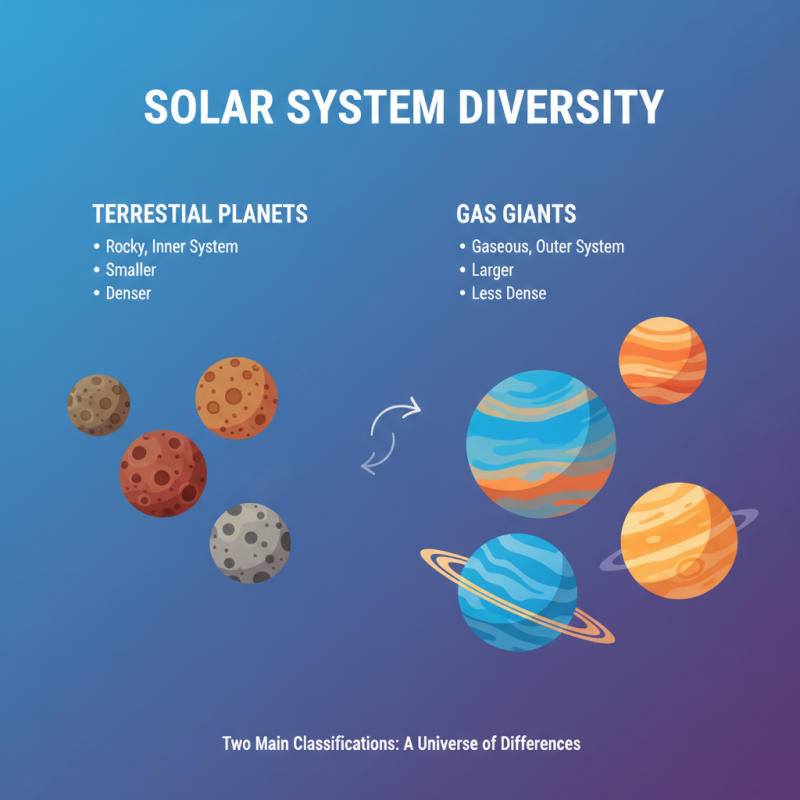
The solar system is diverse. It contains a variety of planets, each with unique characteristics. Two main classifications exist: terrestrial planets and gas giants.
Terrestrial planets are rocky. They include Mercury, Venus, Earth, and Mars. These planets have solid surfaces and are closer to the Sun. They experience temperature fluctuations. For example, Mars has extreme cold at night and warm days. This creates challenges for potential life.
Gas giants, on the other hand, are vastly different. Jupiter and Saturn dominate this category. They lack solid surfaces and are composed mostly of hydrogen and helium. These planets have thick atmospheres and strong winds. Their massive sizes create immense gravitational pulls. Despite their beauty, these giants can be inhospitable. Storms rage on their surfaces, making exploration difficult. Understanding these distinctions helps us appreciate the complexity of our solar system.
The Importance of Orbits: Kepler's Laws and Planetary Motion
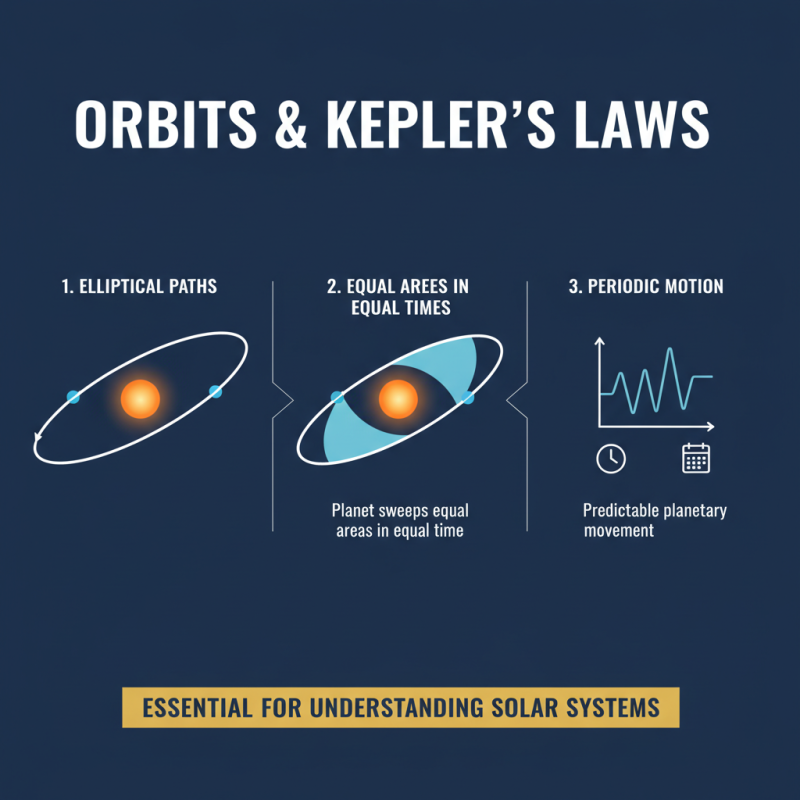
Understanding orbits is essential to grasp how solar systems function. Planets move in elliptical paths around their stars, as described by Kepler's Laws. These laws reveal predictable patterns in planetary motion. They can help us predict where a planet will be at any given time.
Kepler's First Law states that planets orbit in ellipses. This means that their distance from the star changes over time. At times, a planet feels closer and faster. At other times, it seems distant and slower. Kepler’s Second Law explains the speed variation in an orbit. A planet sweeps out equal areas in equal times. This is fascinating!
However, not everything in orbits is perfect. Some planets get too close to their stars, resulting in extreme temperatures. Others might have irregular orbits caused by gravitational pulls from nearby bodies. These scenarios make us rethink our understanding of a solar system. Exploring these nuances invites curiosity and deeper questions about planetary dynamics.
The Role of Gravity in Solar System Dynamics and Stability
Gravity plays a crucial role in the dynamics and stability of the solar system. It is the invisible force that binds celestial bodies together. Each planet, moon, and asteroid is held in its orbit by gravitational attraction. This attraction varies depending on the mass of the object and its distance from others. For example, the larger the mass, the stronger the gravitational pull.
In our solar system, the sun is the most massive object. Its gravity keeps the planets circling around it. Consider the delicate balance that exists. If a planet drifts closer, it might be pulled in. Too far, and it could escape the sun's grasp. This constant interplay can lead to instability, causing orbits to shift or collide over millions of years.
Yet, there are gaps in our understanding. Scientists do not fully comprehend how gravitational forces shape distant objects. Some regions remain turbulent and chaotic. Are there hidden forces at play? With each discovery, we realize how little we know. The solar system is both a marvel and a mystery.
Understanding the Role of Gravity in Solar System Dynamics